3D Printing: How to Choose the Best 3D Printer for You?
Sep
3D Printing: How to Choose the Best 3D Printer for You?
3D printing has become a technology that is much more accessible than in the past. Previously, 3D printers were expensive and complex to operate, typically found only in companies, factories, and design centers. Today, however, almost anyone can purchase a suitable 3D printer, set it up at home or in a workshop, and begin printing the models and parts they need.
However, with the vast number of printers available on the market, the real challenge arises when trying to choose the right one.
You might find a low-priced printer alongside one that costs several times more, and you will notice that different manufacturers use varying terminology and specifications. Therefore, it is inaccurate to claim that there is a single “best 3D printer” for everyone. The best printer depends primarily on what you intend to print, the materials you will use, the size of the objects, the level of detail required, and your available budget.
In this article, we will explore the key types of 3D printing, the differences between FDM and resin printers, and the factors to consider before purchasing a printer.
What is 3D printing?
3D printing is a method of manufacturing physical objects from digital files. Instead of crafting a part by hand or using a machine to remove material from a larger block, the printer builds the object layer by layer until the desired shape is achieved.
The process typically begins with a 3D model created using 3D design software or obtained from a library of ready-made models. The file is then prepared using software known as a “slicer,” which converts the model into instructions the printer can understand.
One of the most common file formats used in this field is STL, though others—such as OBJ and 3MF—are also used.
Once the file is prepared, it is sent to the printer to begin the manufacturing process.
This method has made it possible to produce a wide variety of items, including engineering models, spare parts, figurines, project components, prototypes, game pieces, character models, and more.
Why has 3D printing become so widespread?
One of the key reasons for the widespread adoption of 3D printing is the significant freedom it offers users to manufacture the specific parts they need.
For instance, if you require a small part that is no longer available on the market, you can design it—or obtain a suitable model and print it yourself, rather than spending a long time searching for it.
3D printing is also highly beneficial for designers, engineers, hobbyists, and small business owners. It allows them to test a new idea by printing a prototype, then modify the design and reprint it as many times as necessary.
In many cases, this saves a great deal of time compared to traditional manufacturing methods.
Types of 3D Printers
When looking for a 3D printer, you will encounter various types, but the two most common among users are:
- FDM printers
- Resin printers
While there are other technologies used in industrial settings, these two types are the most relevant for those looking to purchase a printer for personal use or small projects.
FDM Printers
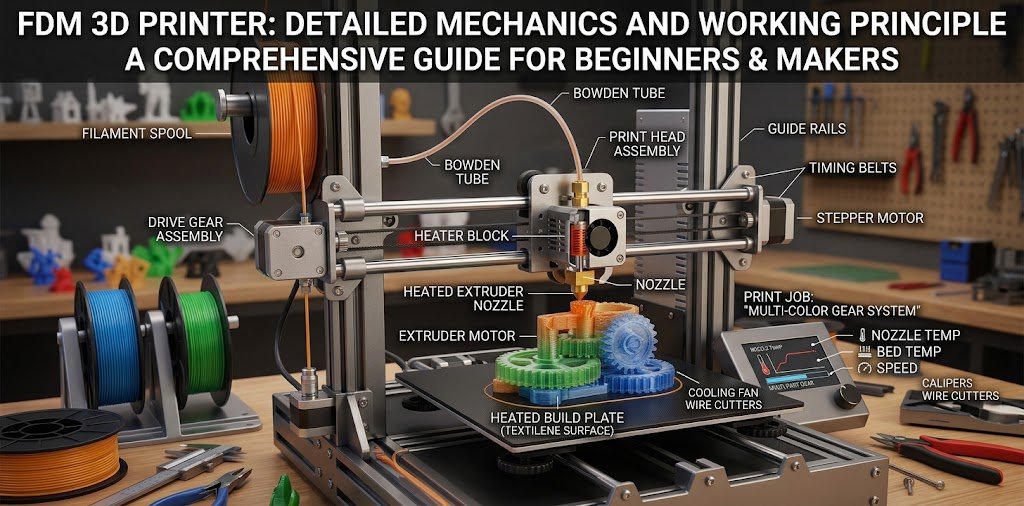
FDM printers are among the most widely used types of 3D printers and are often the first choice for beginners.
These printers use a plastic strand known as “filament,” which is heated and extruded through a nozzle to build the model layer by layer.
One of the most popular materials used with FDM printers is PLA; it is relatively easy to use and suitable for a wide range of models and objects.
Other materials—such as PETG, ABS, ASA, and TPU are also available, each offering distinct properties.
A key advantage of FDM printers is their relatively low printing cost, combined with the wide variety of material types and colors available.
If you need to print large objects, tools, engineering models, or parts requiring good durability, an FDM printer can be an excellent choice.
However, it is important to note that surface quality and the level of detail depend on the printer, settings, nozzle size, layer height, and the material used.
Resin Printers
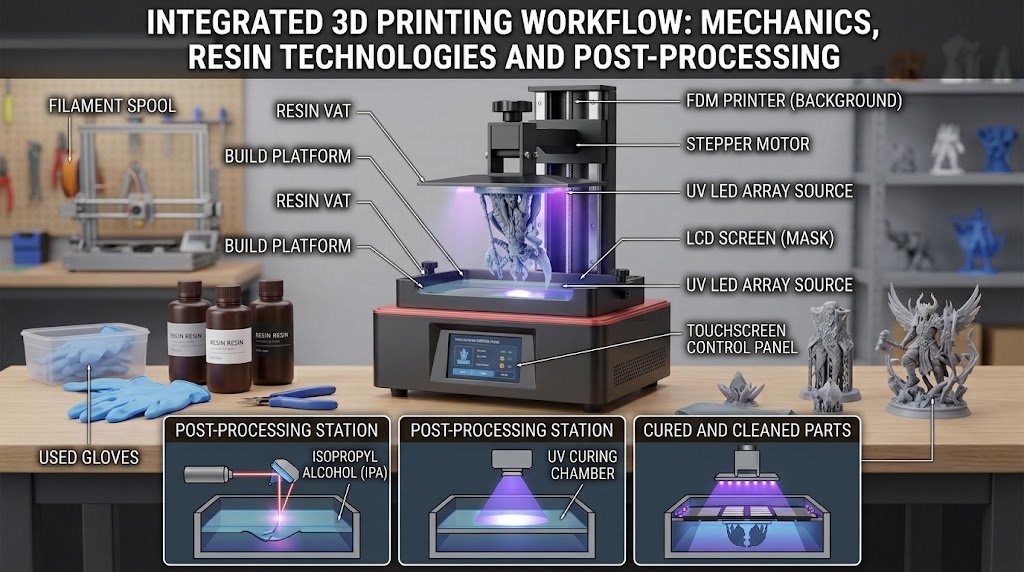
The second type is resin printers, which rely on liquid resin rather than plastic filaments.
This type of printer is known for its ability to produce extremely fine details; consequently, it is widely used for printing figurines, characters, miniatures, and models featuring intricate details.
If your primary goal is achieving fine detail and a smoother surface finish, a resin printer can often be a better choice than an FDM printer.
However, there are a few factors to consider.
Liquid resin requires careful handling, and printed parts typically need cleaning and post-processing after printing is complete. As a result, resin printers may be less straightforward for beginners compared to FDM printers.
It is also essential to ensure a suitable workspace, prioritize proper ventilation, and follow the manufacturer’s instructions when handling resin.
Which is better: FDM or Resin?
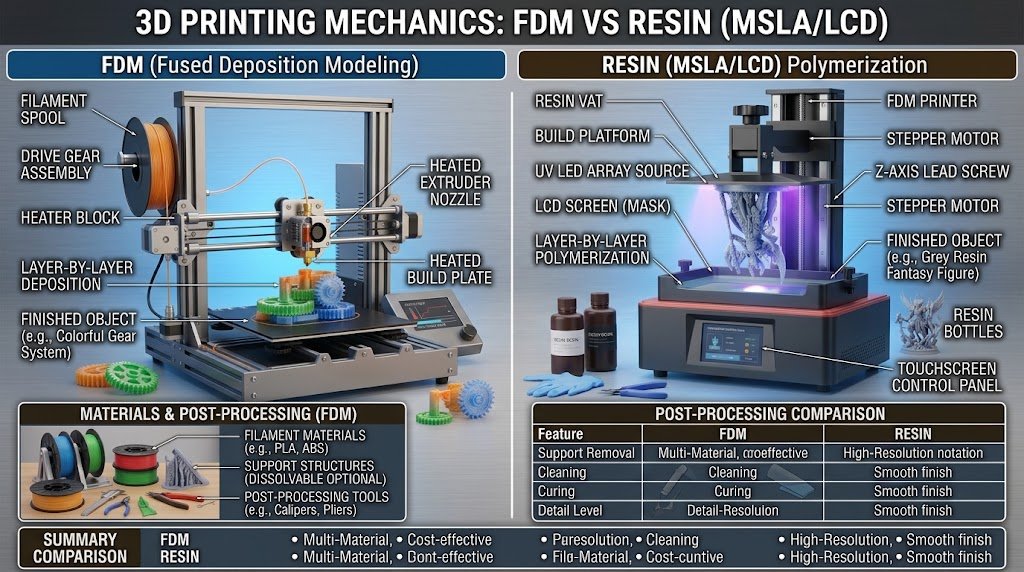
There is no one-size-fits-all answer.
If you want to print large, functional parts and are looking for reasonable operating costs and easier material handling, FDM is often the right choice.
However, if you prioritize intricate details and want to print miniatures, character figures, or highly precise models, Resin might be the better option.
Some people in the 3D printing field own both types, as each technology has its own specific use cases.
How do you choose the best 3D printer?
Before buying a printer, don’t focus solely on the price.
It is best to start by asking: “What do I want to print?”
The answer to this question will determine most of the specifications you need.
- Print Size
One of the most important specifications to consider is the “build volume”—the space within which the printer operates.
If you are printing small parts, you don’t necessarily need a massive printer.
However, if you want to print large figures or long components, it is better to choose a printer with a larger build area.
It is a mistake to buy a large printer simply because of its size if you won’t actually utilize that extra space.
- Print Resolution
Resolution is important, but you shouldn’t look at just a single number in the printer’s specifications.
With FDM printers, you will encounter specifications like “layer height,” which refers to the thickness of the layer printed in each pass.
A smaller layer height can result in finer details and a smoother surface finish, though it may increase printing time.
With Resin printers, other factors come into play, such as LCD screen resolution and pixel size, in addition to the print settings themselves.
Therefore, do not let the phrase “high resolution” be the sole reason for purchasing a particular printer.
- Print Speed
Print speed has become a key factor in modern printers; however, the speed advertised by the manufacturer is not always the speed you will achieve across all types of printing.
Printing a large, complex model differs significantly from printing a small, simple piece.
Furthermore, significantly increasing the speed may require precise setting adjustments to avoid compromising the model’s quality.
For this reason, it is better to seek a balance between speed and quality rather than simply chasing the highest number.
- Ease of Use
If you are a beginner, this point is crucial.
A printer might boast excellent specifications, yet require considerable expertise to set up and configure. Conversely, you might find another printer that is much easier to use, even if its specifications appear lower on paper.
It is beneficial to look for printers featuring automatic bed leveling, error detection capabilities, easy nozzle or build plate replacement, and a clear user interface.
These features can save you a great deal of time, especially if you plan to print frequently.
- Availability of Spare Parts and Materials
Before purchasing a printer, verify the availability of spare parts and materials in your country, or ensure they can be easily obtained.
Over time, you may need a new nozzle, build plate, belt, or other components.
You should also ensure the availability of the appropriate filament for FDM printers or resin for resin printers.
A cheap printer for which spare parts are hard to find can end up being more expensive in the long run.
- Software
The printer is not the only component in the printing process.
You will need “slicer” software to prepare your models before printing. Therefore, it is best to ensure that the printer works well with popular slicer software and that ready-made settings files—or profiles—are available to help you get started quickly.
The quality of the 3D file itself is also crucial.
Even the best printer in the world cannot produce a good model if the 3D file itself contains errors.
Don’t Rely Solely on Specifications
A common mistake when buying a 3D printer is comparing only the figures listed in the specifications table.
You might find two printers with similar prices and specifications, yet the user experience differs vastly between them.
That is why it is beneficial to read user reviews and watch real-world tests of the printer, rather than just looking at photos and advertisements.
Look for models printed by others and examine the quality of details and surface finish, the ease of setup, and any issues encountered.
This information can be far more useful than the raw numbers found on a product page.
What About Printing Materials?
The choice of material depends on the printer type and the intended use of the printed part.
For FDM printers, PLA is one of the most widely used materials, especially for beginners and for printing models and figurines.
PETG is a suitable choice when you require properties different from those of PLA.
There are also materials like ABS and ASA for applications requiring specific properties, as well as flexible TPU.
Resin printers offer various types of resin, such as Standard, Tough, and Water-Washable resins, among others.
No single material is best for every situation; therefore, the material should be selected based on the specific part and its intended use.
The Importance of the 3D Model
The printer is just one part of the printing process.
The 3D model itself significantly impacts the final result.
You might own an excellent printer, but if the model contains mesh errors, excessively thin walls, or features unsuitable for printing, issues may arise during the print job.
Therefore, it is crucial to use well-designed 3D files that are optimized for printing. This highlights the importance of selecting ready-made 3D model files from reliable sources, especially when the goal is actual printing rather than simply viewing the model on a computer.
Do you need an expensive printer?
Not necessarily.
If you are just starting out with 3D printing, it is best to define your needs first rather than buying the most expensive printer available.
A mid-range printer may well be sufficient for printing most of the items you require.
As you gain experience, you will better understand the specifications you actually need, and you can then upgrade to a more advanced printer if your work demands it.
The most important thing is to avoid paying for specifications you will not use.
Conclusion
Choosing the best 3D printer does not depend on the brand name, the price, or the highest advertised speed.
Making the right choice begins with understanding the type of models you intend to print.
If you need large, functional parts and wish to use materials like PLA and PETG, an FDM printer might be the right choice.
However, if your primary focus is on figurines and intricate, fine details, a resin printer might be better suited for you.
Before purchasing, always compare factors such as print volume, print quality, speed, ease of use, and the availability of spare parts and materials, while also considering real-world user experiences.
Ultimately, there is no single printer that can be described as the best for everyone. The best 3D printer is the one that aligns with your specific needs, usage habits, and budget.
With high-quality, well-designed 3D files, 3D printing can transform a digital design on your computer screen into a tangible object that you can use, test, or further develop.